·

IN-DEPTH 2027

Unveiling the interior of planetary bodies, from geodesy to the search for habitable environments

An in-person workshop for PhD students and early-career researchers on how gravity, tidal and magnetic data are turned into models of planetary interiors.

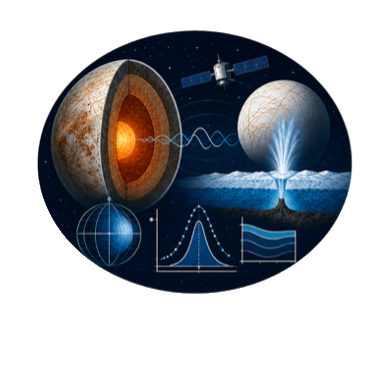
IN-DEPTH 2027 workshop logo

Welcome to IN-DEPTH 2027

A hands-on workshop on forward modelling and Bayesian inversion of planetary interiors.

Gravity fields, tidal deformation and induced magnetic fields are most of what we can measure about the inside of a planet or a moon. Linking them to a model of the interior means solving two problems. The forward problem predicts what a given internal structure would produce. The inverse problem works back from the data to the set of structures that fit them, and to how well each parameter is constrained.

Juno has measured the tidal response of Io, and JUICE and Europa Clipper will return gravity, altimetry and magnetic data for Ganymede, Europa and Callisto. Reading these data requires numerical models that couple non-linear rheology, heat transport and multiphase dynamics, together with statistical methods that can handle the non-uniqueness of the solution.

The workshop brings together about 20 PhD students and young postdocs. Each part of the programme starts with lectures and continues with a hands-on session: participants build a finite element model, then run a Markov chain Monte Carlo inversion on synthetic data. A final round table looks at how the uncertainties on interior parameters translate into ice shell thickness, ocean depth and dissipated tidal power, which are the quantities that matter when assessing whether an ocean world could be habitable.

Three phases and a round table

From the measurements to the models and back.

  1. Observational constraints and planetary geodesy

    Gravity field, moment of inertia, Love numbers and induced magnetic fields, and how radio science, laser altimetry and magnetometry measure them.

  2. Forward modelling

    Conservation equations, convection, viscoelastic and visco-elasto-plastic rheology, multiphase systems. Hands-on finite element modelling.

  3. Inverse problem and Bayesian inference

    Likelihood, non-uniqueness and uncertainty quantification. Hands-on MCMC inversion of structural parameters from simulated data.

  4. Round table

    From interior parameters to ocean depth, crust thickness and dissipated power, and ideas for joint work after the workshop.

Organisers and support

The workshop is organised by researchers at INAF-IAPS and Sapienza University of Rome. Travel grants for participants are funded by the Società Italiana di Scienze Planetarie Angioletta Coradini (SISP-AC).

INAF, Istituto Nazionale di Astrofisica IAPS, Istituto di Astrofisica e Planetologia Spaziali Sapienza Università di Roma SISP, Società Italiana di Scienze Planetarie Angioletta Coradini

Programme

Lectures first, then hands-on work on the same topics.

Phase 1

Observational constraints and planetary geodesy

The first phase covers the observables that constrain the interior of a body and the techniques used to acquire them: radio science based on spacecraft tracking, laser altimetry and magnetometry. For each one we discuss the quantitative link between the measurement and the internal properties it is sensitive to.

  • Gravity field and harmonic coefficients
  • Moment of inertia
  • Tidal deformation and Love numbers
  • Induced magnetic fields
Phase 2

Forward modelling

The second phase introduces physical models of planetary interiors built from conservation equations, with attention to the rheology of rock and ice and to systems where melt or water coexist with a solid matrix.

  • Conservation equations
  • Convection and heat transport
  • Viscoelastic and visco-elasto-plastic rheology
  • Multiphase systems
Hands-on session

Building a finite element model, with boundary conditions and constitutive laws chosen for a real planetary body.

Phase 3

Inverse problem and Bayesian inference

The third phase moves from data to models. Participants see how to write a likelihood for geophysical observables, how to explore a parameter space where many solutions fit the data, and how to report the resulting uncertainties.

  • Building the likelihood
  • Dealing with non-uniqueness
  • Uncertainty quantification
Hands-on session

Running a Markov chain Monte Carlo algorithm to infer structural parameters from a simulated dataset.

Closing

Round table

The uncertainties on interior parameters are carried over to quantities of astrobiological interest, such as ocean depth, crust thickness and dissipated power. The discussion is also the place to plan joint projects among participants and speakers.

Lecture notes, example codes for modelling and inversion and the synthetic datasets used in the hands-on sessions will be shared with participants.

Daily schedule

How to apply

About 20 places, assigned on the basis of CV and motivation.

Who can apply
PhD students and postdocs

Aged 35 or under at the time of the workshop.

Application deadline

The application asks for a short CV and a motivation statement.

What we expect

  • Basic knowledge of physics and geophysics.
  • Familiarity with numerical methods.
  • Some experience with scientific programming, since the hands-on sessions involve writing and running code.

Selection

Applications are evaluated on CV and motivation. In forming the group we also look for participants from different Italian institutions and for gender balance, and we give attention to applicants with limited funding for travel.

Travel grants

The Società Italiana di Scienze Planetarie Angioletta Coradini (SISP-AC) funds four to five SISP-AC Travel Grants, which cover travel and accommodation for selected participants. You can ask for one in the application form.

Key dates

    Application form

    Open the application form

    Info & logistics

    Practical details for planning your trip.

    When

    The workshop is held in person.

    Where

    Getting to Rome

    Rome is served by Fiumicino and Ciampino airports, and Roma Termini is the main railway station, with high-speed trains to most Italian cities. Directions to the venue will be posted here once the room is confirmed.

    Accommodation

    Participants arrange their own accommodation. Those who receive a travel grant will get the details on what is covered together with the notification of selection.

    What to bring

    A laptop for the hands-on sessions. Instructions for installing the software used in the exercises will be sent to selected participants before the workshop.

    Organisers & contacts

    The people behind the workshop.

    Write to us

    For questions on the programme, applications and travel grants.

    Institutions

    INAF, Istituto di Astrofisica e Planetologia Spaziali (IAPS)
    Sapienza University of Rome, Department of Mechanical and Aerospace Engineering

    Organising committee

    • Matteo Paris
      PhD student, Sapienza University of Rome, and research fellow at INAF-IAPS
    • Antonio Genova
      Associate Professor, Sapienza University of Rome, INAF-IAPS affiliate
    • Anna Maria Gargiulo
      Postdoctoral researcher, Sapienza University of Rome
    • Gabriele Boccacci
      PhD student, Sapienza University of Rome
    • Martina Ciambellini
      PhD student, Sapienza University of Rome
    • Tommaso Torrini
      PhD student, Sapienza University of Rome